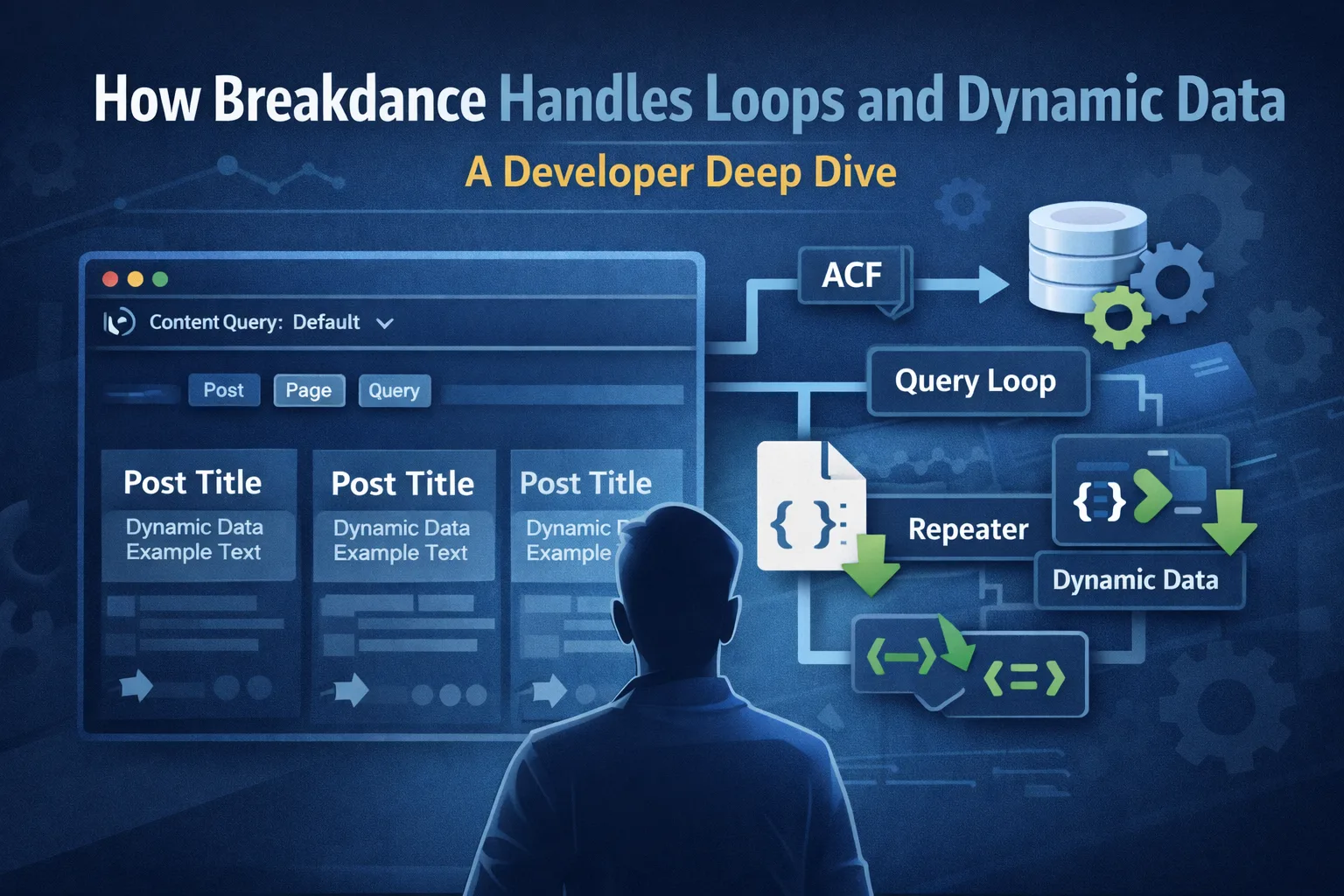
Breakdance handles loops and dynamic data through query loop elements, repeater-based rendering, and dynamic data bindings. These systems allow developers to visually loop through posts, custom fields, and datasets while still following native WordPress query principles.
One of the biggest reasons developers choose Breakdance Builder over traditional page builders is how it handles loops and dynamic data. Unlike older builders that rely heavily on shortcodes or opaque query logic, Breakdance exposes dynamic data in a way that feels closer to native WordPress development.
This developer deep dive explains how Breakdance handles loops and dynamic data, how repeaters and queries work under the hood, and what performance considerations you should keep in mind when building dynamic layouts at scale.
What “Loops and Dynamic Data” Mean in Breakdance
In WordPress terms, a loop is any system that iterates over a dataset, most commonly posts, terms, users, or custom objects. Dynamic data refers to injecting values from those objects directly into templates.
Breakdance abstracts WordPress loops into visual components, but the underlying principles remain the same as native WordPress querying.
If you are already familiar with WP_Query, get_posts(), or template loops, Breakdance’s approach will feel intuitive.
External reference for WordPress loop fundamentals:
👉 https://developer.wordpress.org/themes/basics/the-loop/
Core Loop Types in Breakdance Builder
Breakdance handles loops and dynamic data primarily through three mechanisms:
- Query Loop elements
- Repeater-based dynamic rendering
- Dynamic data bindings inside templates
Each serves a different purpose.
Query Loops in Breakdance
The Query Loop element is Breakdance’s visual abstraction of WP_Query. It allows you to define what content should be fetched and how it should be displayed without writing PHP.
You can loop through:
- Posts and pages
- Custom post types
- Taxonomy terms
- Author archives
- Custom queries with meta conditions
From a developer standpoint, this is the closest equivalent to writing a manual WordPress loop.
External reference for WordPress query logic:
👉 https://developer.wordpress.org/reference/classes/wp_query/
Performance Considerations With Query Loops
Every query loop runs a database query. Poorly configured loops can:
- Trigger unnecessary meta queries
- Load excessive post data
- Increase server response time
Best practices include:
- Limiting posts per page
- Avoiding unindexed meta queries
- Not nesting multiple query loops on the same page
This ties directly into Breakdance performance optimization, which we covered in detail here:
👉 https://babarilyas.com/breakdance-performance-optimization/
Repeaters and Dynamic Rendering
Repeaters in Breakdance are often misunderstood. They are not always database queries. In many cases, repeaters simply iterate over existing data structures, such as:
- ACF repeater fields
- Relationship fields
- Option sets
- Static datasets defined in the UI
This makes repeaters significantly lighter than query loops when used correctly.
External reference on ACF repeater fields (common Breakdance pairing):
👉 https://www.advancedcustomfields.com/resources/repeater/
When to Use Repeaters Instead of Query Loops
Use repeaters when:
- The data already exists on the post
- You do not need pagination
- You want predictable output
- Performance is critical
Avoid query loops when a repeater can do the job.
Dynamic Data Bindings in Breakdance
Dynamic data bindings are where Breakdance really shines for developers. Almost every text, image, attribute, or conditional setting can be driven by dynamic values.
Common dynamic sources include:
- Post title, content, excerpt
- Custom fields
- Taxonomy values
- Author data
- Conditional logic
This eliminates the need for custom PHP in many cases while still maintaining clean output.
External reference to Breakdance dynamic data concepts:
👉 https://breakdance.com/documentation/dynamic-data/
Conditional Logic and Dynamic Visibility
Breakdance allows conditional rendering based on dynamic values. This means elements can be shown or hidden depending on:
- Field values
- User roles
- Login status
- Query results
From a performance standpoint, conditional logic is preferable to rendering everything and hiding it with CSS or JavaScript.
This directly supports the DOM reduction strategies discussed in our performance guide:
👉 https://babarilyas.com/breakdance-performance-optimization/
Loops, Templates, and Reusability
Breakdance templates make dynamic data scalable. A single template can power:
- Blog archives
- Custom post type listings
- Taxonomy pages
Using templates properly prevents duplicated logic and reduces maintenance overhead.
However, developers should avoid embedding heavy query logic inside global templates. A bloated template affects every page that uses it.
How Breakdance Loops Compare to Custom PHP
For developers coming from traditional WordPress theme development, the biggest question is whether Breakdance loops are “as good” as custom PHP loops.
In most cases:
- Breakdance query loops are sufficient
- Repeaters outperform custom queries for static data
- Dynamic bindings reduce template complexity
Custom PHP still wins for extremely complex logic, but Breakdance covers most real-world use cases cleanly.
Performance Impact of Loops and Dynamic Data
Poorly designed dynamic pages can undo all front-end optimization efforts.
Key performance risks include:
- Multiple nested query loops
- Overuse of dynamic bindings in large datasets
- Uncached queries on high-traffic pages
This is why loop design must be paired with overall WordPress optimization strategies, including caching and query efficiency.
For broader WordPress optimization context, this article complements the approach well:
👉 https://babarilyas.com/woocommerce-speed-plugin-guide-2025/
Developer Best Practices for Breakdance Loops
To use Breakdance loops and dynamic data responsibly:
- Prefer repeaters over queries when possible
- Limit queries per page
- Avoid nested loops
- Keep templates lean
- Test performance before scaling
Measure results using Lighthouse, Chrome DevTools, and server query logs.
When You Need Developer-Level Help
Dynamic layouts scale fast, but mistakes scale faster. If your Breakdance site relies heavily on loops, dynamic listings, or custom data relationships, a developer audit can prevent performance and maintenance issues long term.